Captain Navy Reserve Officer Professor Doctor of Pshychological Sciences Engineer Iliya Petrov Peev
“The man, in his nature, is good!” Model of the Positive Psychotherapy “Each day is a good one!”
– Model of Zen
INTRODUCTION
The twentieth century will remain in the history of mankind as one of the most cruel and sanguinary centuries with two world wars and dozens of local wars. After the “hot” wars came the Cold War between the Eastern and Western Worlds. After the Cold War was over again began the “hot” war – and again in Europe. Towards the end of the century have been spreading doubts concerning the reasonability of the human social constitution.
During the second half of the XXth century has begun re-rationalization and re- estimation of the traditional approaches towards education and towards the psychological health of the people, especially the coming generations. This is helped by the new, effective, personally-oriented pedagogical and psychological technologies. Among them clearly distinguished is the positive psychotherapy, established in 1969 by Nossrat Peseschkian M.D., Ph.D., President, International Center for Positive Psychotherapy Inc ICPP.
We must underline that the positive psychotherapy appeared much more earlier than the new political thinking. It was presage and ambassador of the new, peaceful constitution in Europe on the verge of the XXth and XXIth centuries. If we make use of the theory of the field of Kurt Levin, we will see that the main vector of the political space in new Europe is humanization of the man and complete development of the personality. The idea of Positum – that the man is united and inseparable, has come to the fore! Instead of the opposition and alienation are coming the ideas of social unity and completeness. New categories in life are realized: synchronization, synergy, interaction, integration.
THE POSITIVE PSYCHOTHERAPY AS AN AMBASSADOR AND HERALD OF NEW VALUES AND HUMAN CULTURE IN UNITED EUROPE OF THE XXIth CENTURY
The positive psychotherapy does not arise out of an empty spot. It is based on the fundamental philosophical and social doctrines of the XIXth and XXth centuries. The roots of the idea of Positum are deep – they obtain power from the school of the positivism whose founder is the French philosopher Auguste Comte (19.01.1798- 05.09.1857). He also created the system of the positive politics. Auguste Comte
revealed the essence, meaning and application of the positive spirit (Positum) as he made a complete characteristic of it (Comte, A 2000, p. 52-23):
- In its oldest and most common meaning positive means actual, the counterpart of chimerical.
- Contrast of the useful and the useless.
- He qualified the opposition between certainty and hesitation. It is connected with creation of logical harmony in the individual and the spiritual community.
- Opposition between the accurate and the vague.
- The word positive is used as a counter-word of the word negative. The positive spirit and the positive philosophy organize, do not devastate!
- The positive spirit is the base for the actual resolution of the different social crises.
Auguste Comte made a fundamental discovery (Comte, A 2000, p. 70-71): In every subject, the positive spirit always leads to establishment of exact harmony between the ideas for existing and the ideas of motion, constant interrelation between the ideas for organization and the ideas of life, endless solidarity between the ideas for order and the ideas for progress. The progress becomes a compulsory aim of order!

The discovery of Auguste Comte was made in the mid XIXth century but the practice falls behind the theory – especially in the field of the consciousness and the real behavior of the human. Irrespective of the discovery of Auguste Comte, the diplomacy in Europe and the world didn’t change and it incited the world in the XIXth and XXth century to aggression, wars and regress. Why? Because the positive spirit had inspired only a small part of the people – mostly famous teachers and philosophers. The positive
spirit hadn’t seized the politicians, the statesmen, the majority of the common people. For this reason on the territory of Europe were lead two world wars and the local wars haven’t stopped.
After the end of World War II, after 100 years from the discovery of Auguste Comte, the diplomacy in Europe has partially begun to perceive the positive spirit – in 1949 was created the European Council.
However, parallel with the creation of the European Council began the Cold War between the East and the West which made the people stand against one another – like the war between the South and North in the American Continent used to do 200 years ago.
A new stage in the development of the positive spirit began with the creation of the positive psychotherapy by Nossrat Peseschkian in 1969. The positive psychotherapy became possible because of the synthesis of the eastern and western cultures and psychologies. The positive psychotherapy showed the diplomats and the world that the East and the West, as well as the North and the South shouldn’t oppose but unite in their interests, values, cultures and human spirits.
The idea of the positive psychotherapy itself is created thanks to the synthesis and interaction between the East and the West as an ancient and new culture, values, individual and mass psychology. The human spirit understood as Positum is inseparable, united and complete! This is the message of Nossrat Peseschkian and the thousands of his pupils to the new diplomacy of Europe and the World!
The positive psychotherapy has changed the way of thinking of a lot of people who have realized the need of unification not of disunification – in personal as well as in national aspect.
All said until now gives us reason to draw the conclusion that the positive psychotherapy is the first ambassador of new Europe of the XXIth century – there is no European country in which it is not introduced. The positive psychotherapy as a messenger of new Europe and as a good diplomat didn’t stay only in Europe. After it was created in the heart of Europe it has been accepted cordially also in the countries in the other continents.Why does the positive psychotherapy as the first ambassador in united Europe find such a cordial welcome? We’ll search for the answer in the following three directions:
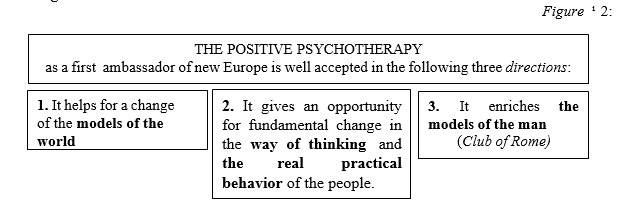
- Positive psychotherapy helps for a change of the models of the world.
It is known that each epoch, religion, system creates its own model of the world. The big variety of models of the world we can put in three main groups (Watts, A 2000, p. 16-18):
Table ¹ 3:
| ² model | ²² model | ²²² model |
| Political model Christian-Judaic, Muslim model | Dramatical model Hindu model | Organic model Chinese model |
| Western Civilization | Civilization in India | Civilization in China |
| Western idea for God as an artist, creator and ruler of the world | God is not the creator and owner but the executor of this world Each one of us is God. | The world is seen as an organism and is developing organically (Dao) Dao feeds up on Love. |
| Psychotherapy – changes the conscience | Hinduism – changes the conscience | Buddhism, Daoism– changes the conscience |
The first model of the world is based on the politics and it is based on the submission, fear and obedience. This model symbolizes the power – the power of God, the power of the ruler (king, tzar, despot, statesman, chieftain), of the party, of the economical and military groups.
Interesting is the role of the psychotherapy in the first model, especially that of the positive psychotherapy. According to Alan Watts, if in the West there is something that resembles the other two models then this is the psychotherapy but not all forms of the psychotherapy (Watts, A 2000, p. 21). We can be certain in saying that the positive psychotherapy resembles the other two models as it brings new conception for the man and the world.
The positive psychotherapy helps the western civilization give up some phenomena that lead to the distruction of the former civilizations. If we use the phrase of the English historian Arnold Toynbee (14-04.1869-22.10.1975) – author of the fundamental work “Study of history”, this is shaking off of the so called “mirage of the immortality”(Huntington, S 1999, p. 437). The phenomenon “mirage of the immortality” reveals itself in the following: when a person or a civilization reaches high levels in its development, it begins to congratulate itself with constant bliss, global expansion; feels the world in a different way and considers human history for finished. This actually is a symptom for its decay as Samuel Huntington says (Huntington, S 1999, p. 437). As in the human – when the sickness of the society doesn’t get timely treatment, the final decay occurs. So was with all vanished empires: the Roman, The Mongol, The Ottoman, etc.
The positive psychotherapy and the positive spirit bring new vision to the man and his world, new understanding of the world’s order – as a result of the positive spirit in each subject the progress becomes compulsory aim of the order! The human self- defines himself – here the position of the historian Arnold Toynbee and that of the psychotherapist Nossrat Peseschkian completely coincide! Toynbee applies positivistic historiography and Peseschkian creates positive psychotherapy.
We are witnesses of two processes: differentiation and integration. Each one of the civilizations keeps its identity but there is also a process of integration going on. The positive psychotherapy is actually a synthesis of the eastern and western cultures. The process is bilateral:
- The values of the western civilization – freedom of the individual, political democracy, principle of the law, human rights and cultural freedoms are perceived by the other nations and they become Asian, African, Near East;
- Because of its nature, the positive psychotherapy resembles the organic model (the Chinese model, the model of the Buddhism and Daoism) and the dramatic model (the Hindu model) of the world! In this sense the positive psychotherapy plays the part of a corrective of the psychological sight and helps the liberation of the man in the western society of his fears, obedience and docility. Like the positive psychotherapy the new European diplomacy also casts aside the fear, obedience and docility.
The positive psychotherapy concentrates not only on the problems of the separate individual or the problems of a group of individuals as it is with the other kinds of psychotherapy. The positive psychotherapy like the other two models concentrates on the problems that are characteristic for every individual! In this way is created a harmony and interaction in the views:
- According to the positive psychotherapy each man in his nature is good (and not only the separate man or the group of individuals). The mayor of the London City Mr. Clive Martin has reason to say: “All citizens of the world are one and the same!” (Milcheva, E 2000)
- According to Zen each day is good (not only the separate day).
Such position brings a lot of new elements in the new European diplomacy of the XXIst century: all nations are good, all people are good, all countries are good. According to the positive approach there are no bad nations and no bad countries. Therefore countries and nations proclaimed for bad, cannot be judged by other countries and nations that assume the role of good ones and from this position administer justice and fairness, impose peace, security and protection according to their believes, values and interests.
In connection with this we can once again see the common between the epochal deed of the holly brothers Cyril and Methodius who created the Slavonic alphabet and the positive psychotherapy created by Nossrat Peseschkian and distributed in Bulgaria by Arno Remmers . 14 centuries ago St. Cyril Philosopher brilliantly defended in Venice the thesis for the necessity of the diversity of the human languages, cultures, religions. To the attacks of the bishops and priests St. Cyril Philosopher replied: “Doesn’t God send rain equally to everyone? And doesn’t the sun shine on everyone? And don’t we all equally breathe the air? And you are not ashamed that you recognize only three languages (Judaic, Greek and Latin) and that you command all other nations and tribes to be blind and deaf? We know a lot of nations that understand books and praise God each in their own language.” (Dinekov, P 1966).
The modern Europe gives the world an example for a new model of life of the nations. In Europe originates the idea of the positive spirits as a theory and the idea of
the positive psychotherapy as a practice. The positive psychotherapy, through the radical change of conscience, helps the affirmation of the other two models of the world that are based on the freedom, unity, integrity and inseparability of the human spirit, understood as Positum and aimed towards progress. The discovery of Auguste Comte is realized – as a result of the positive spirit in each subject the progress becomes a necessary aim of order!
- The positive psychotherapy gives an opportunity for fundamental change in the way of thinking and the real practical behavior of the people.
The change is a basic necessity and main instinct of the human. The positive psychotherapy gives us new answers to the questions for the change in the human and the civilizations. There are many conceptions according to the questions: “How does the man change and how do the human civilizations change?”. Here are two of them:
Conception of Carrol Quigley – all previous civilizations have passed through seven stages: a) copulation; b) pregnancy and birth; c) expansion; d) epoch of conflict; e) universal empire; g) decay; h) foreign invasion (Huntington, S 1999, p. 54). He forecasts that the western civilization will end its existence around the 2500 year and will be replaced by new civilizations in China and India.
Conception of Nossrat Peseschkian – suggests five-step model of the human relationships: a) Observation/Distancing; b) Inventory; c) Situation encouragement; d) Verbalization; e) Goal expansion, extension.
According to us this model gives a better prospect of the development of the human and the world because it is connected with the broadening of the goals, with the unity of the personality and the world, with the harmony, the humanism and the positive side of life.This model better characterizes the processes of differentiation and integration of the contemporary civilization.
- The positive psychotherapy enriches the models of the human.
A lot of universities, science organizations and institutions present models of the human. Among them is also the Club of Rome, founded in 1968 as a non-government organization in which the scientists participate with their personal qualities without representing any group or country( the Club of Rome and the Positive Psychotherapy are of the same age!). Periodically the scientists from the Club of Rome develop different models of the man and his world. The Club of Rome is a world community of people who think globally. In spite of the controversial estimations of the work of the Club of Rome and the presented by it models, the interest of the scientific and political public towards them is very big. In March, 1972 in the USA were published the results of the first research of the Club of Rome “The Limits of the Growth”, known also as the first report of the Club of Rome. This report has turned into “a bible” for a lot of people (Leibin, V 1984, p.15). The world in the new century needs a “new bible” and that is the model of the man and the society, based on the Positum! The positive psychotherapy can give its contribution to the popularization and realization of this model in the XXIst century!
THE ROLE OF THE POSITIVE WAY OF THINKING IN THE PURSUIT OF THE BULGARIAN REPUBLIC TO ITS INTEGRATION TO THE EUROATLANTICAL VALUES AND STRUCTURES
The positive psychotherapy can play a considerable part in the international relationships. The application of the positive approach leads to reinforcing the trust and integration between the nations. We will give two examples, that concern a different period of 100 years:
The first example is connected with the beginning of the XXth century and we will represent it in the form of a popular in the Bulgarian Republic story:
“When king Ferdinand Coburgotski took over the government of Bulgaria most problems created the shopps (peasant of the Sofia district). The shopps are an ethnical group in the region of the district of Sofia, famous with their oppositional behavior, skepticism, conservativity and reluctance to change. Due to their originality the shopps hardly give in to government. The king had an idea to change the character and the customs of the shopps. He decided to use the following didactic method: King Ferdinand sent a shopp in England with the task to study the European culture. So the king believed that the shopp will receive an European mentality, will come back to Bulgaria and pass the new values and the new manner of behavior to the rest of the shopps. The king believed that in this way all shopps will become Europeans and won’t hamper his government of the country.
For a teacher of the shopp the king chose a famous English lord. As a gratitude
king Ferdinand gave the lord as a present beforehand the most beautiful automobile of his palace – a brand new “Ford”.
The shopp went to England. The lord started training and educating him. The shopp, however, didn’t want to learn the new language or the new culture. He spoke with the lord only in his native shopp dialect and didn’t change his behavior.
The lord felt that the experiment was turning out to be a failure. Instead of the shopp getting to know the European culture, the lord learned the shopp language, forgot his aristocratic manners and took in the behavior of the shopps. After six months the English lord didn’t have the psychological strength and sent king Ferdinand the following telegram written in a shopp dialect: Ferdinand, come and take your shopp. I don’t want your “Ford”. Signature: “The Lord”!
In the spirit of this story we can draw the following conclusion: King Ferdinand and the English lord didn’t know the language of the positive psychotherapy due to which the didactic experiment failed.
The second example is from the end of the XXth century and picture is totally different:
Up to 1992 in the Bulgarian Republic the language of the positive psychotherapy wasn’t so popular. For 8 years the positive way of thinking and the positive spirit have become very popular. In the language of the positive psychotherapy speak not only the psychologists and psychotherapists in the Bulgarian Republic. This language began to penetrate in the political vocabulary, it penetrated even in the military field. An
example of this give the prime minister and the president of the Bulgarian Republic who put an accent on the positive way of thinking and the positive behavior.
Figuratively speaking – in 1992 the first ambassadors of United Germany in the Bulgarian Republic were the psychotherapists – Dr. Nossrat Peseschkian and Dr. Arno Remmers. As a result of the positive psychological “invasion”, in the course of 8 years in the language of Positum began speaking the prime minister and the president. The Bulgarian society already speaks freely the language of the first ambassadors of United Europe – the founders of the positive psychotherapy and its disciples! Dr. Peseschkian and Dr. Remmers, thank you from the bottom of our hearts!
To illustrate the dynamic in the change of the public opinion in the last 10 years in the Bulgarian Republic due to its pursuit of membership in the European Union and NATO we will briefly use the five stages of the model of the positive psychotherapy:
² stage: Observation/Distancing:
After the Bulgarian Republic officially addressed its wishes for membership in the Euroatlantic structures, it was observed and evaluated from a distance, for a long time. In February, 2000 the General Secretary of NATO Mr. George Robertson on his visit here said: “Bulgaria is coping very well with its tasks!” (Robetson, G 2000).
²² stage: Inventory:
Professor Geoffrey Sacks characterizes the uniqueness of Bulgaria in this way: “There is no other place on Earth where under such low incomes there is gathered so much intelligence. This, combined with the broadening of the communications and the creation of transnational firms is the Bulgarian chance of attracting investors and raising the incomes.” (Sharabov, G 2000).
²²² stage: Situation encouragement:
- Encouragement by the others:
Geoffrey Sacks: “The good news is that the European Union has accepted the candidature of Bulgaria and has started formal negotiations with it for membership. Europe seems in a very good shape nowadays and that creates very good positions for Bulgaria in the future. What is disappointing for me is that the European Union is acting very slowly towards the expansion.” (Sharabov, G 2000).
Mr. George Robertson: “Your desire to enter NATO is a tough and ambitious project. We will encourage the Bulgarian nation and help it.” (Robertson, D 2000).
- Encouragement by oneself, self-encouragement, self-approval.
The Bulgarian writer Victor Paskov, who has been living for a long time in Germany, shares the following: “We can ensure ourselves the approval of Europe if we act right and are very persistent in this. But it is a hundred times better to approve ourselves!” (Iolova, I 2000).
²V stage: Verbalization:
The verbalization is realized in different ways from the institutions and officials who are responsible for the joining of Bulgaria to the new structures:
“Your stability is a clear signal for the investors abroad”; “Your country needs foreign investments. So, to you will come the economical prosperity as in the other
parts of Europe.”; “In first place should be the joining of democratic Europe. I think that this will happen sooner than the bureaucrats in Brussels think.”
V stage: Goal expansion, extension:
Here are three standpoints of the fifth stage that concern the joining of Bulgaria to NATO and the European Union:
“The joining to NATO is an insurance for the future. We should look forward and take bold decisions now.” (Robertson, D 2000).
“It is necessary for you to have democratic form of government, free market economy, strict citizens’ control upon the military, peaceful relationships with the neighbors” (General Ralston 2000).
An opinion of Mr.Claive Haidn Martin – mayor of the London City: “The process of joining is an enormous and extremely tough work. We will continue to encourage the economics here to go on with its successful efforts in this direction. If the reforms in your country continue with the same rate, your country will become a nice place for investments.” (Milcheva, E 2000).
These are only fragmentary samples of estimations and conclusions, corresponding to each one of the five stages of the positive psychotherapy. They illustrate only the inexhaustible potential opportunities of the positive psychotherapy in the international life. For now in the international relationships the positive approach is yet not so well mastered and the methods of the force – economical, military, political, informational
,dominate. For the XXIst century lies ahead the task to introduce the methods of the positive psychotherapy in the international relationships. The first diplomatic message was made by the positive psychotherapists. The second message is due to be made by the professional diplomats. The rest will be done by the politicians, the statesmen and the nations. So the fifth stage will be reached – expansion of the goals in front of humanity from the global world of the informational century. The challenge remains!
CONCLUSIONS AND SUGGESTIONS:
- The positive psychotherapy should be studied in the preparation of officials of the state administration, politicians, diplomats, statesmen, officers.
- The positive approach should be introduced in the leading of international negotiations – especially in a state of crises and resolution of military conflicts.
- The positive psychotherapy should be introduced as a subject in the schools and universities.
- As we have in mind the experience of the scientists of the Club of Rome, the International Center for Positive Psychotherapy the following should be organized:
- In 2001 – the first year of the XXIst century, should be held a meeting of the followers of the positive psychotherapy with state and political officials, as well as with the leaders of the governments and the political leaders of the European countries, on which should be discussed the matters of the positive spirit in the international relationships and the resolution of crises and conflicts with the help of the positive psychotherapy. At the meeting should be invited scientists from the Club of Rome with
the help of whom should be worked out the positive model of the man of the informational society and the globalizing world.
- A declaration should be accepted and announced in the media by the 2nd World Congress for Positive and Transcultural Psychotherapy or by the International Center for Positive Psychotherapy, in which should be characterized the global crisis in the world nowadays. In the declaration should be made an appeal towards the resolution of the global problems and the surmount of the crisis situations through introducing of the positive approach in the international relationships. An example of this should give United Europe! The declaration can be sent to the United Nations, The World Peace Council, the European Council and be distributed also on the Internet.
LITERATURE:
- Bauman, Z (1999). Globalization. The outcomes for the man. “LIK”. Sofia.
- Vojtila, K (1994). The Pope Ioan Pavel II. Personality and act. “Nov den”. Sofia.
- Comte, A (2000). Treatise on the positive spirit. “COHM”.Sofia.
- Dinekov, P (1966). Old-Bulgarian Pages. Anthology. “Bulgarski Pisatel”. Sofia.
- General Ralston, D (2000). We highly appreciate your participation in ÊFOR. – newspaper “Bulgarska armia”, ¹ 14 924/23-29.06.2000, p. 3.
- Huntington, S (1999). The clash of civilizations and the remarking of world order. “Obsidian”. Sofia.
- Iolova, I (2000). The script for Bulgaria is a life-asserting pornography. Conversation of Iva Iolova with the writer Victor Paskov. – newspaper “Trud”, ¹ 129/15.05.2 000, p. 9.
- Leibin, V (1984). “Models of the world” and the image of the man. Critical analysis of the ideas of the Club of Rome. “Nauka i izkustvo”. Sofia.
- Milcheva, Å (2000). Your joining to the European Union requires a lot of work. Conversation with the London City Claive Martin. – newspaper “Trud”, ¹166/21.06.2000, p. 9.
- Peev, I (1996). Psychological aspects of the security. – In.: Security through partnership and integration. Bulgaria, NATO and the European architecture of the security. “Bulgarian association of investigations of the European society”. Sofia.
- Peseschkian, N (1994). Method of Positive Psychotherapy. Volume 1. “Colour print”. Varna.
- Peseschkian, N (1993). Positive family psychotherapy. “Color print”. Varna.
- Peseschkian, N (1998). Positive psychotherapy of the daily round. “Slavena” Varna.
- Peseschkian, N (1996). 33 plus one forms of partnership. “Color print”. Varna
- Peseschkian, N (1994). The merchant and the parrot. “Color print”. Varna..
- Robertson,D (2000). Mr. George Robertson, General secretary of NATO. Visit in Bulgaria. Newspaper “Trud” from 11.02.2000, p. 9.
- Sharabov,G (2000). You don’t need IMF but growth (conversation with Geoffrey Sacks, economical advisor of Petur Stoyanov) – newspaper “Trud”, ¹ 119/05.05.2 000, p. 9.
- Watts, A (2000). The Philosophies of Asia. “LIK”. Sofia.
ADDRESS:
- Captain Navy Reserve Officer Professor Doctor of Pshychological Sciences Engineer Iliya Petrov Peev
- Mobile: + 359 898 359 647 (Viber & WhatsApp)
- Home: + 359 52 757 472
- E-mail: ippeev@abv.bg